



hen you are part of the jury in a jewellery competition, you inevitably hope to discover, among all the participants, a designer whose name will one day be written into the history of jewellery. The moment of choice is always fascinating. What lies behind each drawing, each creative intention: a unique gaze, a distinctive language, a talent in the making?
The Bucherer Fine Jewellery competition was born from the meeting between Antonio Teixeira, director of the Bucherer boutique in Geneva, and Richard Carbonnelle, deputy master in charge of the Jewellery and Gemsetting department at the Centre de formation professionnelle arts (CFP Arts). For the past four years, it has celebrated transmission, high standards and the future of the jewellery professions.
Each edition shines a light on young creators at the end of their final year of training, at that fragile and decisive moment when, armed with their know-how, they are about to leave school and enter the professional world.

This competition is deeply inspiring. Each year, Bucherer invites students to create around an imposed theme. This edition brought together the plant world and a 4.82 ct pear-shaped pink pinkish red tourmaline, both the source of inspiration and the central challenge of the competition.
The winner receives this gem in order to bring to life the jewel they have designed. Throughout the creative process, the students benefit from the guidance of Richard Carbonnelle, their teacher Emmanuelle Garcia Gavillet, as well as the attentive eye of Nicolas Youssoufian, Jewellery Department Manager, and Frédérique Berman, expert and head of private clients at Bucherer.
The complete dossiers presented to the jury - composed of jewellery industry figures and including Europa Star Jewellery - revealed far more than a simple stylistic exercise. Arguments, preparatory research, sketches and gouaches were all driven by fertile imagination. But how can such projects be judged when each one reveals a singular universe and very clearly defined choices?
There was the precious comb inspired by the Gerbera and designed by Manon Rossi, who won second place, as well as the brooch inspired by the martagon lily of our mountains, designed by Eliott Benagas, which won third prize. The first public prize was awarded to Léa Bernerd’s delicate necklace; as for the vegetal earring by Inès Genève, whose volutes climbed up to the forehead, it earned its creator the second public prize. Each creation told a story and sketched out a world.

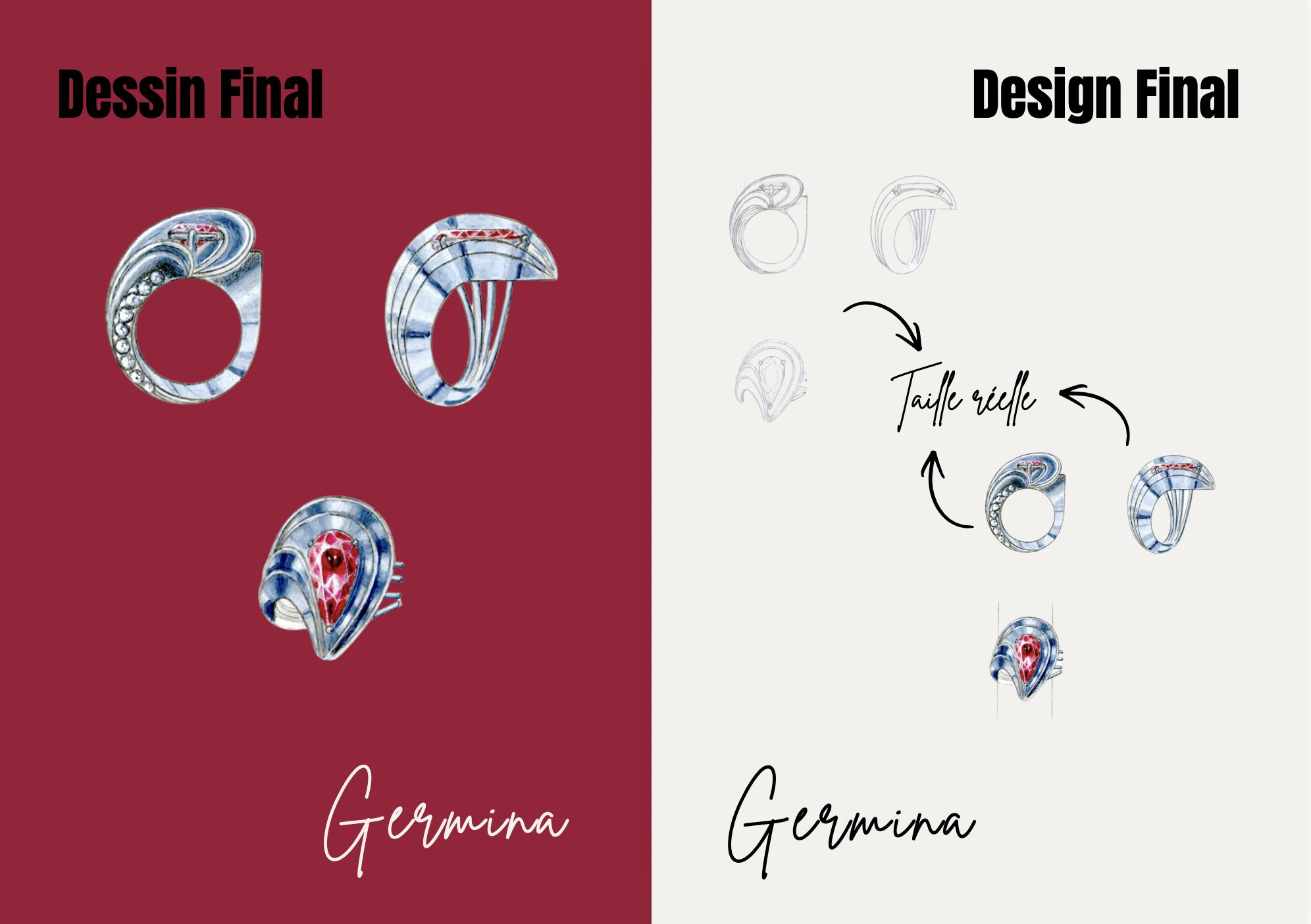
But let us return to the winner. The superb Germina ring imagined by Ahmad Torkmany won first prize in the Bucherer Fine Jewellery competition. The student received the tourmaline in order to create his piece, which was unveiled for the first time in early May at the heart of the GemGenève fair. A ring with a complex, almost architectural structure, composed of silver leaves folded like waves, one of which is set with zircons along its edge. Having tried it on, I can say that it wears beautifully: because of its asymmetry, the stone seems to rest on the neighbouring finger, forming an elegant hand ornament.
Over the years, this competition has grown in scope and become a springboard for these young talents at the dawn of their careers. For example, following her victory, the winner of the 2024 edition, Fanny Lienhard, was admitted to the prestigious Haute École de Joaillerie in Paris. She has since joined the team of a Parisian jeweller.
We met Ahmad Torkmany during GemGenève. He spoke to us about his journey, exile, his arrival in Switzerland - a land that has become for him a promise of the future - and his dreams...
Europa Star Jewellery: What was your path before winning the Bucherer prize?
Ahmad Torkmany: I was born in Syria to Palestinian parents, and most of my family still lives there. I arrived in Switzerland at the age of 19. Today, I am 27. Before that, I had never studied jewellery: everything I have learned in this field, I discovered here, in Switzerland.
Do you come from a family of jewellers?
No, I come from a family of architects and engineers. When I was a child, I often went to my uncle’s house; he was a great architect in Syria. He would give me sheets of paper and I would spend hours drawing technical and architectural forms. He meant a great deal to me and was a true role model.
How did your taste for jewellery develop?
One day, when I was still a child, my mother took me to a jeweller. I was fascinated by what I saw in the displays: objects of a beauty I had never imagined before. I observed the jewellery, its construction, its styles, and I told myself that later on I would like to become a jeweller and watchmaker. Creating watches and jewellery became a childhood dream that never left me, despite the difficulties I encountered later.
You mention difficulties. Are you willing to talk about them?
When the war broke out in Syria, we were forced to leave the country and my whole family settled in Lebanon. There, I did not have the opportunity to study jewellery or watchmaking. So I studied pastry-making and became a baker and pastry chef, while also doing internships in architecture with my uncle. My family expected me to become an architect or an engineer, like other members of my family.
How did you come to study jewellery at CFP Arts?
Eight years ago, my mother, my six brothers and I joined my father, who was already living in Switzerland. When I arrived, I first entered a school to learn French. Then I completed several internships in jewellery workshops in order to understand the differences between jewellery made here and the jewellery I knew in Syria. After that, I took the entrance exam for CFP Arts in Geneva and was accepted. At school, I discovered jewellery-making, the behaviour of metals, drawing and design. During my studies, I also took part in a jewellery competition. It was a very important experience.

How did you arrive at these very graphic volute forms?
The idea for this ring came after visiting the Bucherer boutique. There, I discovered magnificent pieces, especially jewellery worked with gradients of stones. Since the theme of the competition was “the plant world”, I went to observe flowers: the way petals fall, their movements, their delicacy. I also reflected on the notion of protection: that of the cocoon in which the chrysalis develops before becoming a butterfly, or that of seeds and buds preserved before they bloom. My ring is therefore inspired by the intimacy and softness of the plant world. The design seeks to express this idea of protection through an enveloping form, while retaining great visual lightness.
What were the greatest difficulties you encountered?
I made a huge number of sketches before arriving at the final design. I tested different movements for the petals, but I could not achieve exactly what I had in mind. So I made a model in order to better understand the proportions and volumes. Only after that work was I able to draw the definitive piece.
What is your dream for the future?
My dream is to become a watch and jewellery designer. I would first like to work for major houses in order to develop my know-how and refine my style. Then, once I have gained enough experience, I would like to create my own brand and put my signature on it.
You mention your signature: how would you describe your style?
I seek to reveal the hidden architecture of nature: its mysteries, its lines, its invisible structures. I like to draw attention to those details that are rarely noticed but that give nature all its beauty. I want to imagine elegant and singular jewels that reflect who I am.
What does this Bucherer prize mean to you?
I believe that passion and perseverance are the keys to making dreams come true. I move forward step by step, and winning the Bucherer Prize represents for me both an immense honour and a wonderful opportunity for the next stage of my journey.


