



ore than the setting for the unveiling of the new Alta Gioielleria collection, Taormina was a homecoming. It was here, in 2012, that Domenico Dolce and Stefano Gabbana launched their Alta Moda project to show the most elevated expressions of Italian creativity and craftsmanship. Fourteen years later, the brand comes full circle, returning to where the adventure began and weaving a narrative of jewellery, place, hospitality and memory.
The presentation took place on July 12 at San Domenico Palace, founded in the fifteenth century as a Dominican monastery and now one of Taormina’s most iconic hotels. Stone cloisters and terraces overlooking the bay became the backdrop for the new High Jewellery collection. Created by hand in the brand’s atelier, each piece resonated with the architecture and spiritual dimension of these ancient surroundings.

High Jewellery was the first in a series of presentations that continued with Alta Moda, at the Radicepura botanical gardens at the foot of Mount Etna, then Alta Sartoria in the Teatro Antico in Taormina, culminating in a party at La Plage Resort, opposite Isola Bella, where Jennifer Lopez performed, wearing four custom creations by Dolce&Gabbana. Closing the show, she was joined onstage by Domenico Dolce and Stefano Gabbana, before fireworks lit up the sky above the coastline.
In the words of the creative duo, “High Jewellery was a dream and that we have been able to fulfil this dream has been an extraordinarily moving experience. We let our imagination take flight. Every piece is one-of-a-kind, unique in the world, remarkable for its design, for the refinement and rarity of the precious stones, and for the meticulous attention to detail. These are works of art, crafted by the expert hands of the finest Italian artisans who make each creation an exclusive masterpiece.”

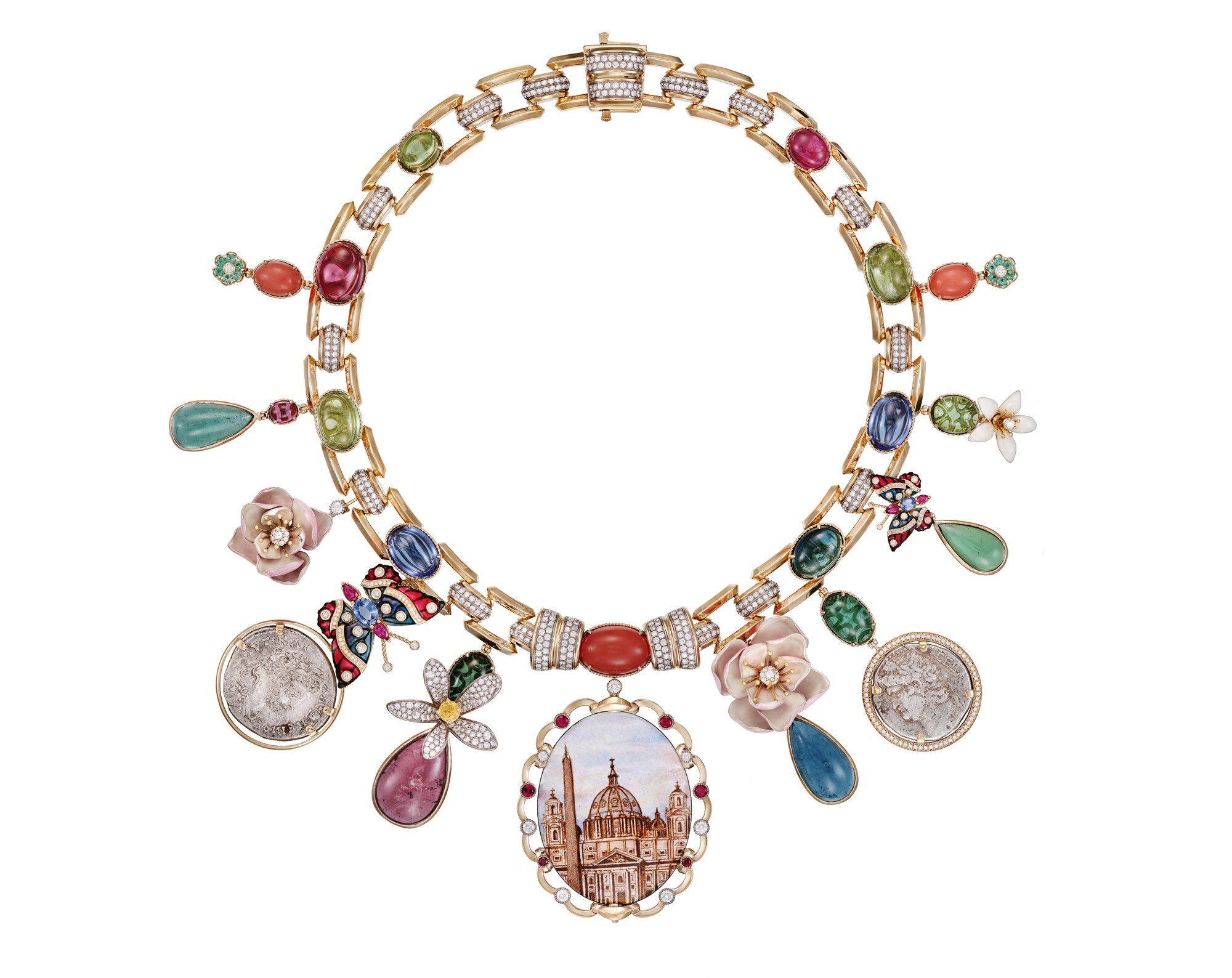
The rare gemstones in question are only the starting point for a collection that brings together multiple techniques — sculpting, enamelling, miniature painting and filigree — and recognisable cultural references. Each jewel becomes its own narrative, a world to carefully observe and discover through visible as well as hidden details.
Already, this same language ran through the Roma 2025 collection, a reflection on the many facets of the Eternal City, from the splendour of the Roman Empire to the glamour of the Dolce Vita and the city’s religious and symbolic significance. In Taormina, Sicily was at the heart of the story, though extending beyond this one geography. The new collection explores religious motifs, the Mediterranean landscape, baroque art and Italy’s artisanal heritage. Spirituality and sensuality, family memories and decorative exuberance cohabit in jewels that are a natural merging of the sacred and the profane.
One of the most emblematic pieces pays tribute to Divina Devozione Siciliana or Sicilian Sacred Devotion, interpreted not just as an expression of faith but as a guiding principle: devotion experienced through love for one’s family, a sense of place, and memories to be treasured and passed on.
The necklace’s centrepiece is a Sacred Heart pendant, surmounted by a diamond crown. Drop-cut rubellites, rubies and diamonds frame the heart, forming rays of light and colour, and accentuating its silhouette. Contained within the heart is a red rose, sculpted and enamelled by hand, like an authentic relic set on burgundy fabric. A symbol of love since antiquity and the flower of Venus, the rose represents the coming-together of human passion and spiritual elevation.
A protective structure of filigree scrolls offers a glimpse of the rose without revealing it in its entirety. This same elliptical movement appears in the rose gold links of the chain, their centre glowing with rectangular pink tourmalines.
Dolce&Gabbana’s gemmological laboratory painstakingly analysed each individual stone prior to selection. Settings were formed by hand, observing the proportions and characteristics of each gem in order to draw out its chromatic depth, transparency and radiance. Colour, red and pink being the dominant palette, is more than an aesthetic device. It becomes the language of faith, love and belonging.

Local traditions, with their emphasis on artisanal skills, are a leitmotif for Dolce&Gabbana’s High Jewellery. The inspiration for a necklace presented in Sardinia, in 2024, came from coccoi pintau, a Sardinian bread associated with the most important ceremonies and religious holidays. The dough is shaped entirely by hand, then carved and decorated using small knives, scissors, rollers and tweezers. No two breads are the same: the maker cuts, sculpts and pinches the dough into an entirely personal and unique form, like a bakery jewel.
Flower-laden branches, rosebuds, hens, chicks and spirals connect with pagan or early Christian symbols, while more enigmatic shapes are rooted in natural cycles and the path of the sun. Translated into the language of High Jewellery, coccoi pintau invites us to reflect on the unique nature of handcrafted objects, the patience they require and how a collective memory can be contained in a decorative form.
A second source of inspiration came from the centuries-old technique of Sardinian filigree, where thin gold wires are drawn then shaped into intricate, lacelike designs. These lightweight, openworked patterns play on line, negative space and geometric repeats to create precious volumes. Present on the island from the first Phoenician settlements, filigree was incorporated into late eighteenth-century aristocratic dress, then traditional ceremonial costumes. Perhaps the most iconic example of Sardinian filigree is the gold button, formed from two domes, worn by brides as a symbol of fertility and prosperity. By reiterating this technical refinement and symbolic significance, Dolce&Gabbana has transformed an element of Sardinia’s material culture into a contemporary creation.
Italy’s regional traditions, such as coccoi pintau and filigree, are retold in the brand’s High Jewellery, year after year, extending the geo-graphy of its collections. These are never slavish reproductions of objects from the past; folklore is never reduced to mere ornamentation. Instead, forms and techniques are reinterpreted in ways that highlight their common ground: patience and time, skills passed from generation to generation, and the unique character that comes from the perfect imperfection of handcraftsmanship.
Accordingly, the collection shown in Taormina does not propose a single representation of Sicily or Italy. It is an assembly of different territories, eras and languages that finds cohesion through craftsmanship. Spirituality meets sensuality, monumentality merges with meticulosity, the refinement of precious stones joins folk tradition and techniques.

The brand’s choice to present the collection to guests at a private event is also indicative of the very nature of the project, which is to build an experience around the jewels that connects object, place and collector.
More than a backdrop, Taormina was the origin, the subject and an integral part of the narrative. By returning to where it all began, Dolce&Gabbana reaffirms a profoundly Italian notion of high jewellery, shaped by its own codes, grounded in craftsmanship and capable of transforming cultural heritage into living creations.
Treasures of devotion, memory and beauty, these jewels contain the emotions of the places and traditions that inspired them. Their story will continue through those who choose them and who will pass them on to generations to come.


