



t Van Cleef & Arpels, nothing is accessory,” says Alexandrine Maviel Sonet, director of heritage and exhibitions for Van Cleef & Arpels, with a smile. In Geneva, The Art of Living by Van Cleef & Arpels presents a selection of everyday objects in precious materials together with emblematic jewellery from the House’s patrimonial collection. Cigarette holders, bill clips and lipstick holders are a reminder of an age when every gesture was a pretext for elegance and style.
Salon 1906: a living patrimony
Named for the year the Parisian jewellery House was founded, and introduced in 2017 at certain flagship boutiques, the Salons 1906 have a mission to “explain Van Cleef & Arpels’ history and show pieces from the collection,” says Maviel Sonet. Europe has only one such Salon, in Geneva. The others are in the United States, China and South-East Asia.
The Salons’ square shape, with display cases at each of the four corners, is symbolic: a subtle but deliberate nod to the architecture of Place Vendôme in Paris.
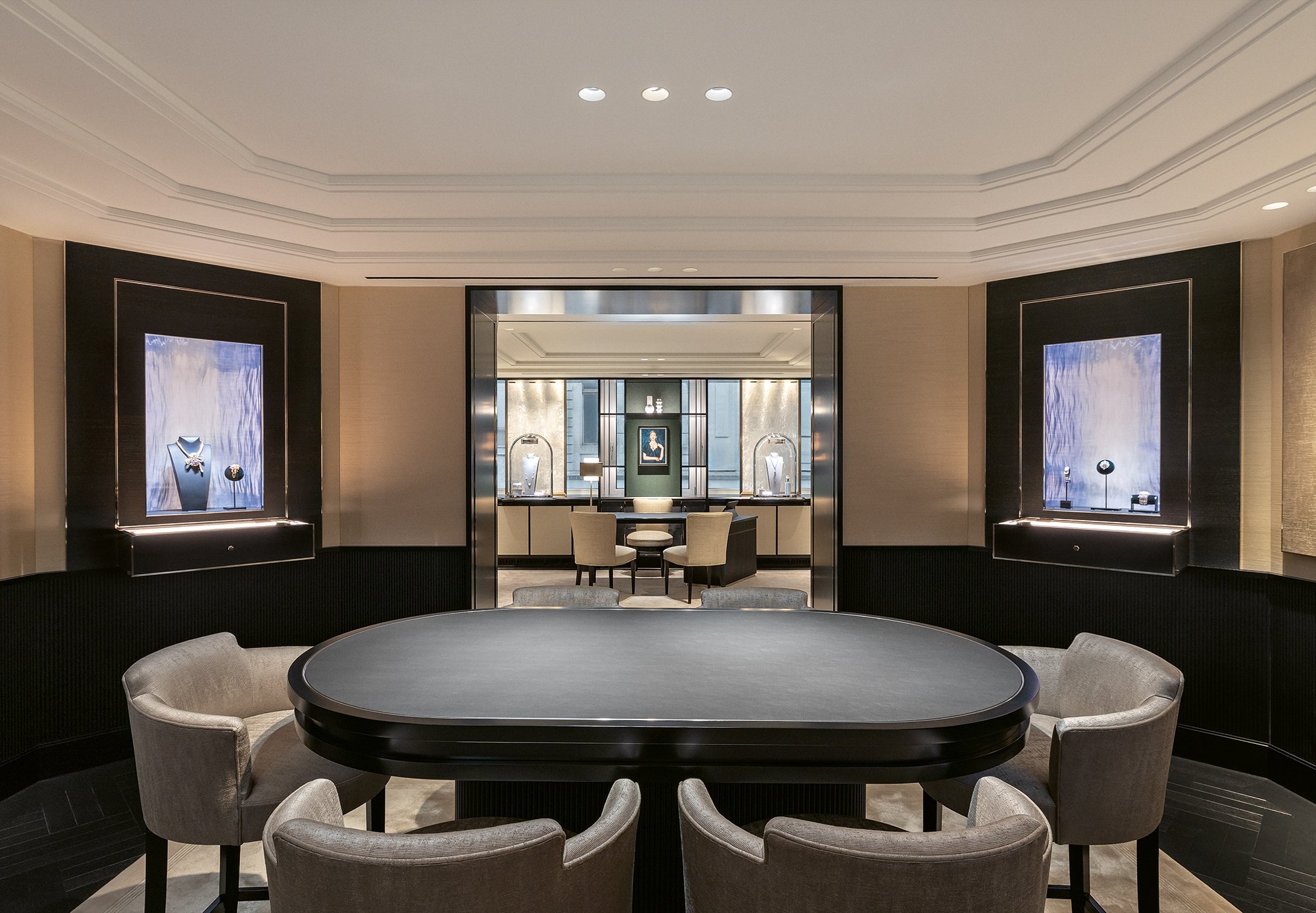
More than twenty accessories, jewellery and gouache renderings are on display in Geneva. “We like to show items in context, alongside drawings, period advertisements and sketchbooks,” continues Alexandrine Maviel Sonet. “Sometimes this includes the patent document, which sheds light not just on the technique but on the mood of the day. This dialogue between the object, the drawing and the period is what makes the exhibition so compelling.”
Essential accessory
From the very beginning, the House’s creations have held a mirror to the aesthetic and habits of an era when, alongside jewellery, Van Cleef & Arpels boutiques offered hat brooches, evening bags and lipstick holders.

“Accessory is something of a misnomer,” insists Maviel Sonet, “as it suggests these objects played a secondary role, which is far from being the case.” One of the pieces, a woven gold evening bag from 1959, still fascinates. “It was one of the stars of an exhibition in Asia. We received so many comments and messages about it in the visitors’ book. Very few were made. It could easily make a comeback today.”

The Zip necklace, symbol of a new era
Every item in the exhibition conjures up an era and a mood. The 1920s ushered in the Art Deco style of symmetrical lines, contrasting black and white, and the first wristwatches: one of the items in the exhibition is a 1921 model in platinum and diamonds on a velvet strap. The 1930s and 1940s saw yellow gold replace platinum, reserved for the war effort. The 1950s introduced the famed Zip necklace, whose design is still blatantly copied, despite the protection of numerous patents.

“When the zip fastener came into use in the 1930s, Van Cleef & Arpels had the idea of creating a precious version. The first patent, filed in 1938, was for a zip-shaped necklace but of course, Van Cleef & Arpels loves transformations so why not imagine a way for this necklace to become a bracelet, too? The technique for achieving this was extremely complex, then war broke out, hence the patent wasn’t filed until 1951. These had been difficult years for women and with peace came a return to elegance and a longing for voluptuous jewels, worn next to the skin, next to the pulse. The Van Cleef & Arpels Zip was born.”
New ways replace old habits
The lifestyles that prevailed throughout the first half of the twentieth century were completely different from those of the twenty-first century. Certain objects that were commonplace then would be out of place today. “The bill clip and watch combination is a typically masculine, wonderfully stylish item but no longer serves a purpose, now that we pay by swiping a card or mobile phone. Possibly it could find a new use as a desk accessory, to hold papers, but no longer as a pocket companion. The notion of transformation, on the other hand, remains intact. Van Cleef & Arpels has always loved these ingenious, dual-purpose objects,” says Maviel Sonet.

Independence goes up in smoke
The cigarette holder, from 1920, is symbolic of a social revolution. Introduced in the late 1800s to prevent tobacco from staining teeth or gloves, the first cigarette holders were a male preserve, reserved for a stylish gentleman and the occasional dandy, later adopted by women who began lighting up in literary salons and bohemian circles. When the Flapper burst onto the scene in the Jazz Age, the cigarette holder became an object of defiance. Hollywood stars, the likes of Marlene Dietrich, Bette Davis and Claudette Colbert, popularised the image of a sophisticated, independent woman cradling a long cigarette holder in her gloved hand.

“In the 1920s, for a woman to smoke or apply make-up in public was an act of rebellion,” Alexandrine Maviel Sonet confirms. “Cigarette holders, which were typically Art Deco, were decorated with onyx and diamonds, black and white, and this contrast reflected women’s audacity. This duality was even seen in Flappers’ scarlet lips, dark-rimmed eyes and short, bobbed hair, which were considered revolutionary at the time.”
A personal object
The Vanarp lipstick holder (a contraction of Van and Arpels) from 1954 wonderfully illustrates this alliance of the personal and the refined, as Alexandrine Maviel Sonet explains: “A woman would go out and buy her favourite lipstick then slip it into a holder such as this. This is typically something a woman would keep with her, a personal item she would rarely take out in public. It’s a gift she would give herself. As an object, it speaks of elegance but also tenderness towards oneself.”

Elegance in every gesture
These accoutrements tell of an age when every gesture – taking out a banknote, lighting a cigarette, reapplying rouge – became a choreography. “People took time. These objects were part of a natural elegance, a demeanour. They made life an art,” muses Alexandrine Maviel Sonet. Crafted between 1910 and 1960, they are also characteristic of a society that placed representation before comfort. We live in an age that prioritises well-being, whereas earlier decades were concerned with appearance, and while representation persists, we express it differently. A pair of trainers that costs several thousands is equally a comment on today’s society: one that speaks of freedom of movement rather than constraints.
The thirteen pieces on display at Salon 1906 in Geneva capture the refinement of these years. “A lipstick holder, a hat brooch or a bill clip encouraged a form of elegance,” Alexandrine Maviel Sonet observes. “As though everyday gestures were elevated by the objects that accompanied them.”
The Art of Living by Van Cleef & Arpels | 27 September 2025 - 10 January 2026 | Salon 1906, 31 Rue du Rhône, Geneva


